
 +86 13713990149
 sales@huceen.com
Application of the H7-1200 Series PLC in a Fruit Juice Production Line
 2026-11-10
 Huceen
Fruit juice is an everyday beverage.
Ensuring that every single bottle tastes just right is a fundamental requirement in the food industry.
Yet, maintaining this consistent flavor profile is no simple task. As food safety standards and quality consistency requirements continue to rise, the level of automation on a production line becomes a critical factor in determining a product’s competitive edge.
At a fruit juice production facility in Henan, this factor has taken a concrete form. From washing, juicing, blending, and sterilization to filling and packaging, the "nervous system" that safeguards the flavor of every bottle is powered by the H7-1200 series Profinet master PLC from Huceen Automation.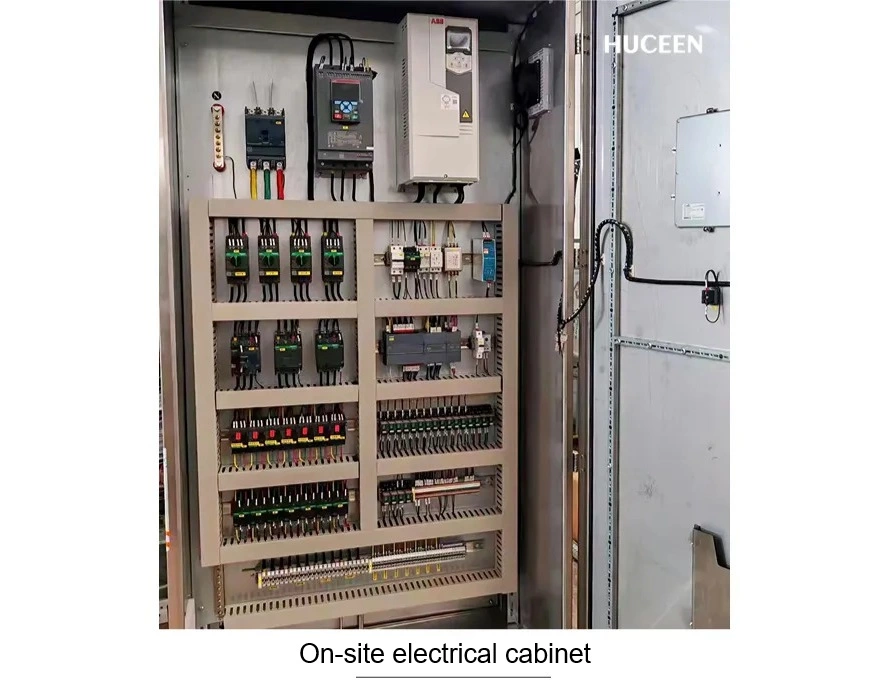
Ensuring that every single bottle tastes just right is a fundamental requirement in the food industry.
Yet, maintaining this consistent flavor profile is no simple task. As food safety standards and quality consistency requirements continue to rise, the level of automation on a production line becomes a critical factor in determining a product’s competitive edge.
At a fruit juice production facility in Henan, this factor has taken a concrete form. From washing, juicing, blending, and sterilization to filling and packaging, the "nervous system" that safeguards the flavor of every bottle is powered by the H7-1200 series Profinet master PLC from Huceen Automation.
Unlike typical industrial environments, fruit juice production entails a unique set of requirements:
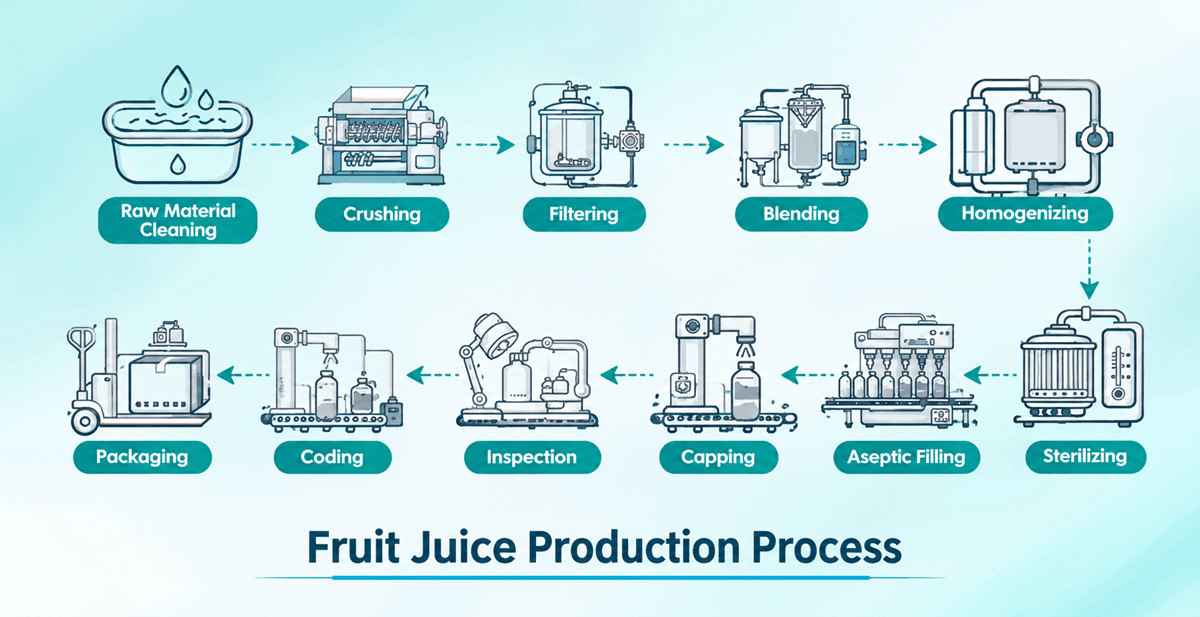
Multiple, tightly-synchronized stages: The process spans 11 distinct stages—from raw material washing to final packaging—that must remain strictly synchronized. A slowdown at any stage can lead to bottlenecks or material shortages, while a complete stoppage could result in the loss of all product currently within the piping system.
High process precision: Parameters such as sugar content, acidity, sterilization temperature, and fill volume are continuous variables. Any drift in these values can lead to inconsistent flavor profiles—or, in more severe cases, the recall of an entire production batch.
Strict data traceability: Comprehensive records of sterilization intensity and batch-specific data are essential for food safety audits and root-cause analysis—a mandatory requirement in this industry.
In short, the production line demands a mature, cost-effective solution capable of covering the entire manufacturing process while ensuring long-term, stable operation.
To address these challenges, Huceen Automation offers a modular architecture centered on the H7-1200 series PLC.
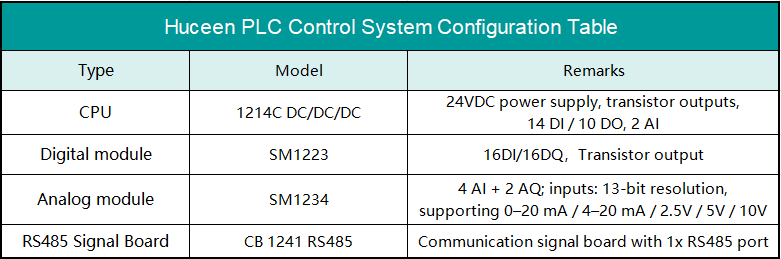
The production line utilizes the H7-1200 series 1214C CPU as the primary controller, managing end-to-end logic operations, PID process control, equipment interlocking, and data processing. Field instruments and variable-frequency drives (VFDs) are connected via an RS485 bus (using the CB1241 module), while the human-machine interface (HMI) and remote maintenance channels are integrated via Ethernet.
Multiple, tightly-synchronized stages: The process spans 11 distinct stages—from raw material washing to final packaging—that must remain strictly synchronized. A slowdown at any stage can lead to bottlenecks or material shortages, while a complete stoppage could result in the loss of all product currently within the piping system.
High process precision: Parameters such as sugar content, acidity, sterilization temperature, and fill volume are continuous variables. Any drift in these values can lead to inconsistent flavor profiles—or, in more severe cases, the recall of an entire production batch.
Strict data traceability: Comprehensive records of sterilization intensity and batch-specific data are essential for food safety audits and root-cause analysis—a mandatory requirement in this industry.
In short, the production line demands a mature, cost-effective solution capable of covering the entire manufacturing process while ensuring long-term, stable operation.
To address these challenges, Huceen Automation offers a modular architecture centered on the H7-1200 series PLC.
The production line utilizes the H7-1200 series 1214C CPU as the primary controller, managing end-to-end logic operations, PID process control, equipment interlocking, and data processing. Field instruments and variable-frequency drives (VFDs) are connected via an RS485 bus (using the CB1241 module), while the human-machine interface (HMI) and remote maintenance channels are integrated via Ethernet.
The H7-1200 series PLC adopts the configuration conventions of mainstream programming software. When upgrading or expanding existing production lines, or replacing spare parts, there is no need to start from scratch—configuration methods, wiring logic, and program structures can all be seamlessly migrated.
Raw Material Pre-treatment
Controls the start/stop and speed (via variable-frequency drives) of the washing machine’s spray pumps, bubble generators, and conveyor belts. Manages automatic feeding and triggers a system halt if material runs out. Provides overload protection, current monitoring, and soft-start functionality for the crusher/juicer to prevent jamming.
Juicing and Filtration
Maintains constant juice extraction pressure through a closed-loop control of pressure and rotational speed. Features automatic backwashing based on differential pressure monitoring, with alerts for clogged filter elements. Uses liquid-level interlocks for feed valves and discharge pumps to prevent overflow or dry running.
Blending
Employs PID control to regulate the addition of syrup and acidulants.
Homogenization and Pasteurization
Uses PID control to manage steam valves for consistent temperature maintenance. Synchronizes pasteurization duration with conveyor speed. Triggers alarms and system halts in the event of temperature deviations (too high or too low), with data logged for full traceability.
Filling and Capping
Utilizes servo-driven filling valves for precise, pulse-based volumetric dosing (accuracy: ±0.5%). Coordinates empty-bottle detection, positioning, filling, and capping; automatically rejects missing or misaligned bottles. Provides real-time monitoring of capping torque.
Post-processing
Employs optical inspection (machine vision) to detect foreign objects, verify liquid levels, and check cap integrity, with automatic rejection of defective units. Integrates with coding/marking equipment to print dates and batch numbers. Synchronizes the timing for case packing and palletizing.
Data Management and Remote Operations
Collects real-time data on temperature, pressure, flow rate, sugar content (Brix), production volume, and equipment status, with full historical traceability. Implements tiered alarm systems for issues such as temperature excursions, overloads, jams, or abnormal liquid levels. Supports remote monitoring, parameter adjustment, and program upload/download via Ethernet or 4G connectivity.
With all 11 process steps integrated, the discussion ultimately returns to a more practical question: what value does this solution bring to the production line?
High-level Integration: A single controller manages all 11 process steps, consolidating logic control, PID loops, equipment interlocking, and data acquisition into one unified system. By integrating digital and analog I/O, RS485, and Ethernet communication, the solution minimizes the need for external expansion modules and reduces the physical footprint within control cabinets.
Simplified Programming: Engineers can leverage familiar programming and configuration methods, eliminating the need for retraining. Standardized function blocks—covering PID control, recipe switching, and interlock protection—allow for rapid deployment; for many process steps, adjustments can be made simply by modifying parameters, significantly shortening delivery and commissioning cycles.
Reliable Operation: Featuring channel-level diagnostics, analog signal filtering, and robust anti-interference capabilities, the system ensures long-term stability—even in the demanding environment of a juice processing facility, characterized by high temperatures, high humidity, and frequent washdowns. Furthermore, a tiered alarm system and remote maintenance access enable most parameter-related issues to be resolved without the need for on-site intervention.
Controls the start/stop and speed (via variable-frequency drives) of the washing machine’s spray pumps, bubble generators, and conveyor belts. Manages automatic feeding and triggers a system halt if material runs out. Provides overload protection, current monitoring, and soft-start functionality for the crusher/juicer to prevent jamming.
Juicing and Filtration
Maintains constant juice extraction pressure through a closed-loop control of pressure and rotational speed. Features automatic backwashing based on differential pressure monitoring, with alerts for clogged filter elements. Uses liquid-level interlocks for feed valves and discharge pumps to prevent overflow or dry running.
Blending
Employs PID control to regulate the addition of syrup and acidulants.
Homogenization and Pasteurization
Uses PID control to manage steam valves for consistent temperature maintenance. Synchronizes pasteurization duration with conveyor speed. Triggers alarms and system halts in the event of temperature deviations (too high or too low), with data logged for full traceability.
Filling and Capping
Utilizes servo-driven filling valves for precise, pulse-based volumetric dosing (accuracy: ±0.5%). Coordinates empty-bottle detection, positioning, filling, and capping; automatically rejects missing or misaligned bottles. Provides real-time monitoring of capping torque.
Post-processing
Employs optical inspection (machine vision) to detect foreign objects, verify liquid levels, and check cap integrity, with automatic rejection of defective units. Integrates with coding/marking equipment to print dates and batch numbers. Synchronizes the timing for case packing and palletizing.
Data Management and Remote Operations
Collects real-time data on temperature, pressure, flow rate, sugar content (Brix), production volume, and equipment status, with full historical traceability. Implements tiered alarm systems for issues such as temperature excursions, overloads, jams, or abnormal liquid levels. Supports remote monitoring, parameter adjustment, and program upload/download via Ethernet or 4G connectivity.
With all 11 process steps integrated, the discussion ultimately returns to a more practical question: what value does this solution bring to the production line?
High-level Integration: A single controller manages all 11 process steps, consolidating logic control, PID loops, equipment interlocking, and data acquisition into one unified system. By integrating digital and analog I/O, RS485, and Ethernet communication, the solution minimizes the need for external expansion modules and reduces the physical footprint within control cabinets.
Simplified Programming: Engineers can leverage familiar programming and configuration methods, eliminating the need for retraining. Standardized function blocks—covering PID control, recipe switching, and interlock protection—allow for rapid deployment; for many process steps, adjustments can be made simply by modifying parameters, significantly shortening delivery and commissioning cycles.
Reliable Operation: Featuring channel-level diagnostics, analog signal filtering, and robust anti-interference capabilities, the system ensures long-term stability—even in the demanding environment of a juice processing facility, characterized by high temperatures, high humidity, and frequent washdowns. Furthermore, a tiered alarm system and remote maintenance access enable most parameter-related issues to be resolved without the need for on-site intervention.
 The application of E7-200 Smart in adsorption regeneration dryer